Method Study

Method Study

WorkMark - Making Invisible Work Visible

WorkMark - Making Invisible Work Visible

WorkMark - Making Invisible Work Visible

Role

Product Design Strategist

Product Design Strategist

What

AI-powered B2B SaaS Platform

AI-powered B2B SaaS Platform

Year

2026

2026

Project Overview

Project Overview

In modern organizations, employees work across multiple tools, teams, and timelines, but much of their real effort remains invisible. Performance is often judged by memory, visibility, and self-reporting rather than evidence.

In modern organizations, employees work across multiple tools, teams, and timelines, but much of their real effort remains invisible. Performance is often judged by memory, visibility, and self-reporting rather than evidence.

WorkMark reimagines performance evaluation by transforming everyday work into structured evidence and a single, transparent performance story for both employees and managers.

WorkMark reimagines performance evaluation by transforming everyday work into structured evidence and a single, transparent performance story for both employees and managers.

WorkMark reimagines performance evaluation by transforming everyday work into structured evidence and a single, transparent performance story for both employees and managers.

Timeline
Timeline

From ideation, research, and testing to final design in 2 weeks

From ideation, research, and testing to final design in 2 weeks

From ideation, research, and testing to final design in 2 weeks

My responsibilities
My responsibilities
  • Defined problem & scope

  • Done competitor Analysis

  • Done qualitative research

  • Conducted stakeholder interviews

  • Defined problem & scope

  • Done competitor Analysis

  • Done qualitative research

  • Conducted stakeholder interviews

  • UX Concept Development

  • AI-Assisted Prototyping

  • UX Concept Development

  • AI-Assisted Prototyping

Background
Background

The contribution workflow within the enterprise platform was lengthy, manual, and inconsistent. Contributors had little guidance, reviewers handled extensive manual categorization, and admins faced challenges in routing and quality checks, leading to delays, rework, and low engagement.

The contribution workflow within the enterprise platform was lengthy, manual, and inconsistent. Contributors had little guidance, reviewers handled extensive manual categorization, and admins faced challenges in routing and quality checks, leading to delays, rework, and low engagement.

82%

82% of remote workers feel unrecognized, driving disengagement and low morale.

45%

Recognition significantly boosts retention, cutting two-year attrition by 45%.

78%

Studies show that 78% of workers who receive recognition show increased productivity

Source - Harvard Business Review's research

Source - Harvard Business Review's research

Source - Harvard Business Review's research

Process

Process

This initiative explored systems-level interactions and decision flows through a conceptual lens. Without access to real enterprise users and given the exploratory brief, the process leaned entirely on secondary sources and analytical reasoning.

This initiative explored systems-level interactions and decision flows through a conceptual lens. Without access to real enterprise users and given the exploratory brief, the process leaned entirely on secondary sources and analytical reasoning.

Research & Insights
Research & Insights

Industry research highlights explainability and trust as major blockers to enterprise AI adoption. McKinsey reports that 40% of organizations view explainability as a key risk, yet few are taking active steps to address it.

This project relied on secondary research, including industry reports from consulting firms (McKinsey, IBM, Gartner), Enterprise AI adoption studies, Articles on explainable AI and human-in-the-loop systems

References: Mckinsey.com, IBM.com, LinkedIn

Who Are We Solving For?

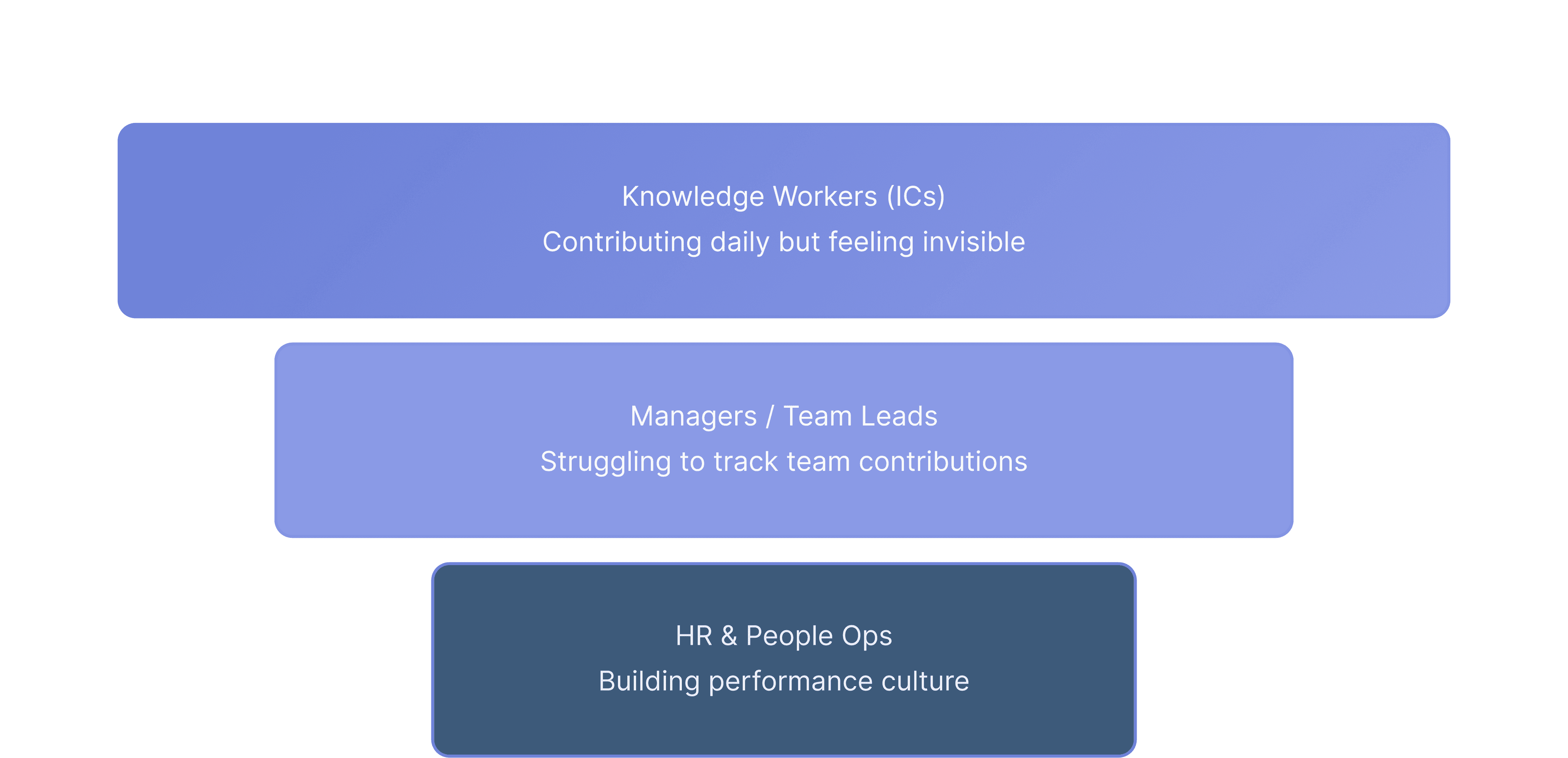
Primary Target: Mid-Scale Organizations
Companies with 50-500 employees operating in the chaos zone—too large for informal recognition, too small for enterprise HR systems.
Why Mid-Scale Organizations?

The recognition challenge varies dramatically by company size. Mid-scale organizations face a unique inflection point

Root cause

Root cause

Why This Problem Exists

The recognition gap isn't about individual failure—it's a systemic breakdown across multiple dimensions. Understanding these root causes is essential to building an effective solution.

1. Tool Fragmentation

Where Work Actually Happens

Modern work is scattered across disconnected platforms, creating blind spots in performance visibility. Organizations use dozens of tools, but none of them communicate with each other.

2. Manager Cognitive Overload

Managers Are Human, Not Databases

The expectation that managers can track, remember, and fairly evaluate all contributions across their team is fundamentally unrealistic. They're juggling their own IC work while trying to support their reports.

3. The Recognition Gap

Expectation vs Reality

There is a massive mismatch between what employees need and what organizations provide. This gap directly impacts engagement, retention, and productivity.

Existing Solutions

Existing Solutions

Do Solutions Already Exist?

Yes , organizations already use multiple tools to manage work, performance, and recognition.
But these tools operate in isolation and fail to capture the full picture of employee contributions.

Yes , organizations already use multiple tools to manage work, performance, and recognition.
But these tools operate in isolation and fail to capture the full picture of employee contributions.

Why Existing Tools Fail

The problem persists because current solutions operate in silos:
- They operate in silos without integration
- They depend on manual reporting and human memory.
- They don't reduce bias, they may even amplify it.
- They don't integrate evidence from where work happens.
- They don't provide continuous, real-time insights.

What's Missing
What's Missing

Between “where work happens” and “where performance is evaluated,” there is no system that converts everyday work into structured, unbiased evidence.

We call this gap the Performance Intelligence Layer.

Between “where work happens” and “where performance is evaluated,” there is no system that converts everyday work into structured, unbiased evidence.

We call this gap the Performance Intelligence Layer.

Between “where work happens” and “where performance is evaluated,” there is no system that converts everyday work into structured, unbiased evidence.

We call this gap the Performance Intelligence Layer.

Market Positioning

Market Positioning

Strategic Capability Matrix

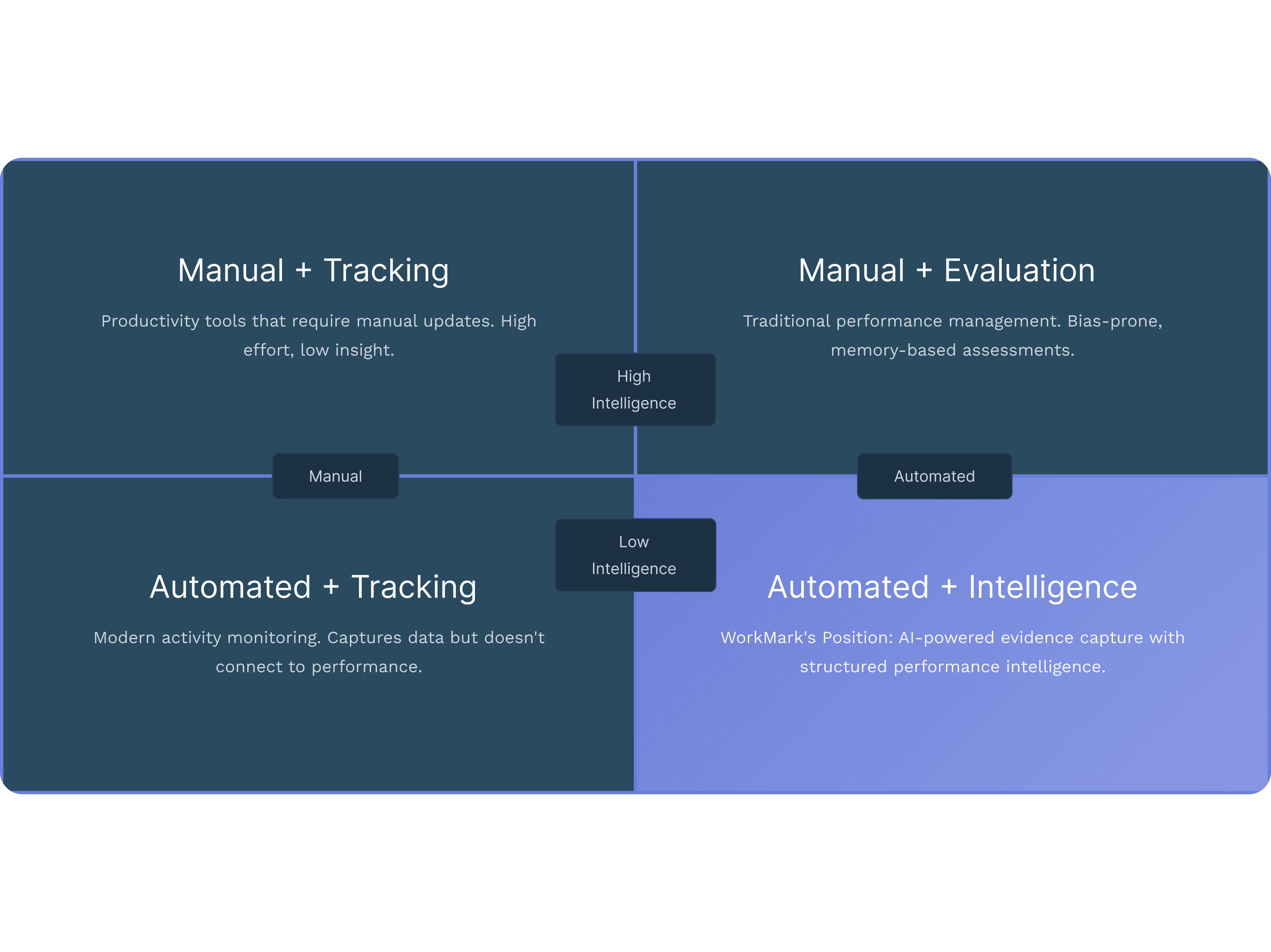
Most existing tools either track work OR evaluate people. But none automatically translate everyday work into structured performance intelligence. WorkMark occupies the missing quadrant where automation meets intelligence.

Most existing tools either track work OR evaluate people. But none automatically translate everyday work into structured performance intelligence. WorkMark occupies the missing quadrant where automation meets intelligence.

User Interviews

User Interviews

Qualitative Research

We conducted in-depth interviews to understand real employee experiences, emotions, and hidden challenges behind performance visibility. We ensured data quality by collecting responses from diverse roles, organization sizes, and tool ecosystems relevant to mid-scale companies.

Who we spoke to → Why → What we asked → What we heard → What it means → What we derived.

Whom do we talk to?
🎯 Total participants: 15 users


Roles: Employees, Managers, HR
Org type: Mid-scale Product/SaaS companies
Experience range: 1–18 years

We conducted semi-structured interviews to explore how performance is tracked, recognized, and evaluated in daily work. Questions focused on visibility, recognition, stress, and fairness.

We conducted in-depth interviews to understand real employee experiences, emotions, and hidden challenges behind performance visibility. We ensured data quality by collecting responses from diverse roles, organization sizes, and tool ecosystems relevant to mid-scale companies.

Who we spoke to → Why → What we asked → What we heard → What it means → What we derived.

Whom do we talk to?
🎯 Total participants: 15 users


Roles: Employees, Managers, HR
Org type: Mid-scale Product/SaaS companies
Experience range: 1–18 years

We conducted semi-structured interviews to explore how performance is tracked, recognized, and evaluated in daily work. Questions focused on visibility, recognition, stress, and fairness.

How might we?
How might we?

Based on our research insights, we framed the following “How Might We” questions to translate user pain points into actionable design opportunities.

  • How might we make invisible work visible without burdening employees?

  • How might we help managers evaluate performance using evidence instead of memory?

  • How might we capture everyday contributions automatically?

  • How might we make performance visibility feel motivating, not stressful?

  • How might we connect work execution tools with performance evaluation?

  • How might we design AI as a supportive coach, not a judge?


Based on our research insights, we framed the following “How Might We” questions to translate user pain points into actionable design opportunities.

  • How might we make invisible work visible without burdening employees?

  • How might we help managers evaluate performance using evidence instead of memory?

  • How might we capture everyday contributions automatically?

  • How might we make performance visibility feel motivating, not stressful?

  • How might we connect work execution tools with performance evaluation?

  • How might we design AI as a supportive coach, not a judge?


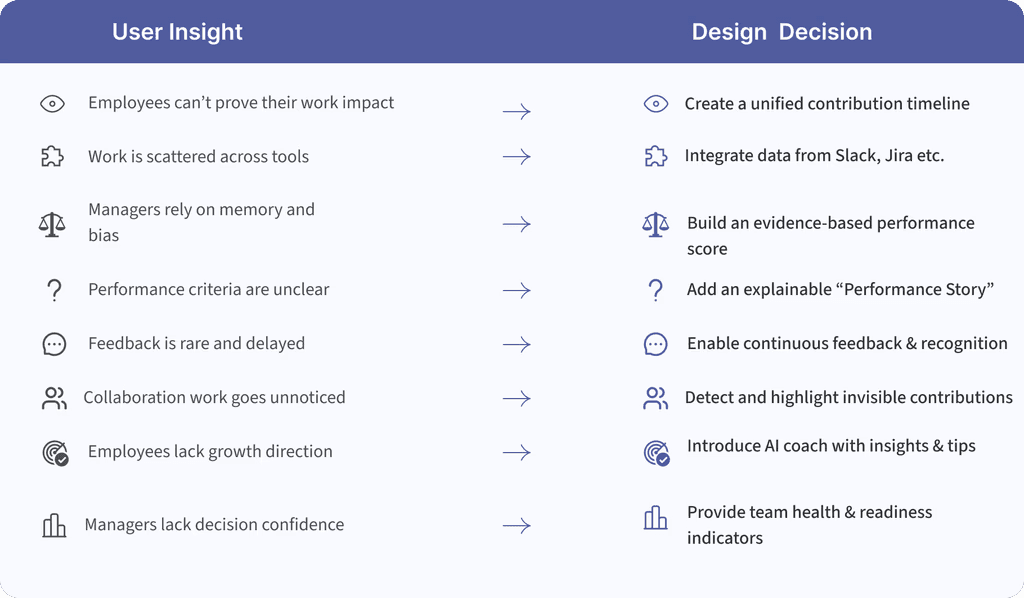
Insight → Design Mapping

How research findings directly informed design decisions


How research findings directly informed design decisions


Quick Solutions
Quick Solutions

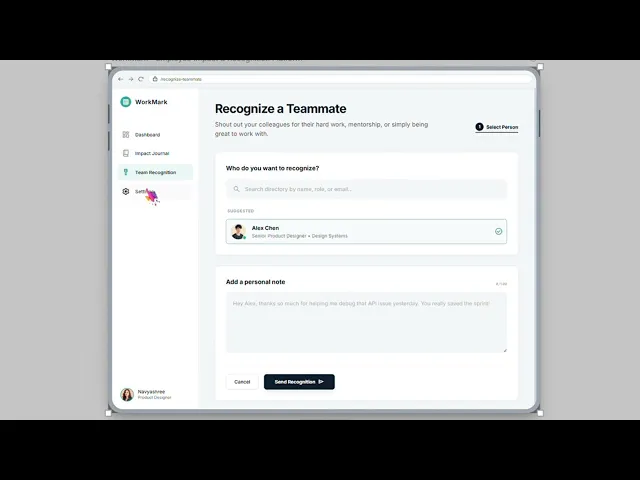
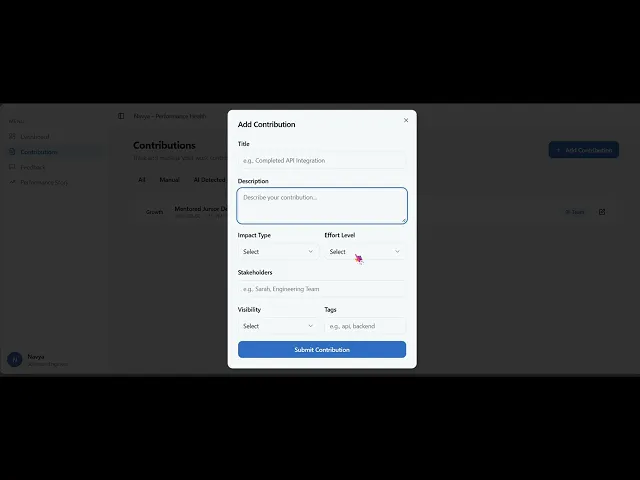
I developed this early-stage prototype in Stitch and Lovable to accelerate visual ideation and test interaction concepts, which we later evolved into the final design.
#Stitch

#Stitch

#lovable

#lovable

User flow
User flow

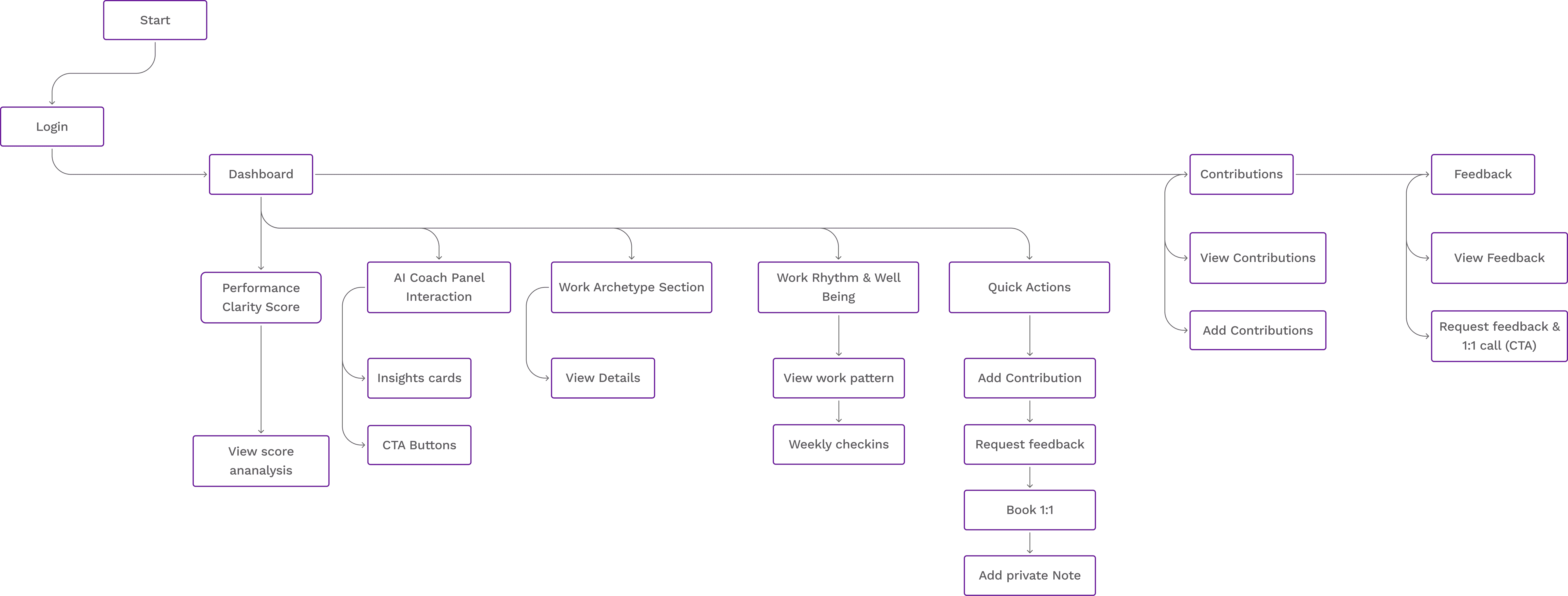
The user flow shows how employees and managers move through WorkMark step by step, ensuring every action feels logical, simple, and aligned with their real-world workflow.

The user flow shows how employees and managers move through WorkMark step by step, ensuring every action feels logical, simple, and aligned with their real-world workflow.

User journey
User journey

Information Architechture

Information Architechture

The Solution

The Solution

WorkMark is a Performance Intelligence Platform that captures everyday employee work, converts it into structured evidence, and translates it into a transparent performance health score, enabling fair, continuous, and data-driven performance evaluation for employees and managers.

WorkMark is a Performance Intelligence Platform that captures everyday employee work, converts it into structured evidence, and translates it into a transparent performance health score, enabling fair, continuous, and data-driven performance evaluation for employees and managers.

WorkMark is a Performance Intelligence Platform that captures everyday employee work, converts it into structured evidence, and translates it into a transparent performance health score, enabling fair, continuous, and data-driven performance evaluation for employees and managers.

Work Capture

Work Capture

Logs work from manual inputs and integrated tools.

Evidence Intelligence

Evidence Intelligence

Evidence Intelligence

Converts activities into structured performance evidence.

Converts activities into structured performance evidence.

Fair Evaluation

Fair Evaluation

Creates a single, explainable performance score.

Creates a single, explainable performance score.

Creates a single, explainable performance score.

Continuous Feedback

Continuous Feedback

Continuous Feedback

Enables ongoing feedback and AI insights.

Enables ongoing feedback and AI insights.

Meet the Team

Meet the Team

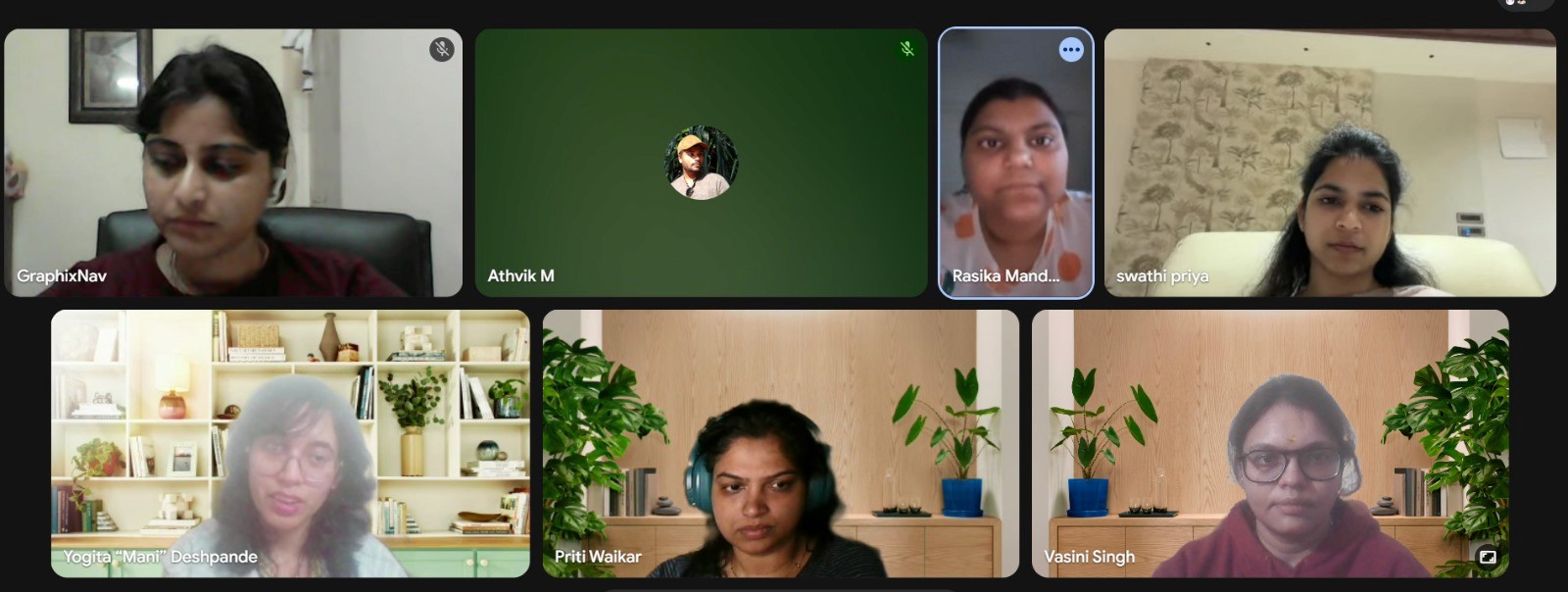
This story belongs to many voices, not one. Each person layered in something vital: compassion, technical skill, design clarity, narrative craft. It showed me how powerful collaboration can be when vision is unified, responsibilities are owned, and communication stays fluid.

This story belongs to many voices, not one. Each person layered in something vital: compassion, technical skill, design clarity, narrative craft. It showed me how powerful collaboration can be when vision is unified, responsibilities are owned, and communication stays fluid.

This story belongs to many voices, not one. Each person layered in something vital: compassion, technical skill, design clarity, narrative craft. It showed me how powerful collaboration can be when vision is unified, responsibilities are owned, and communication stays fluid.

Thank you for reading

Thank you for reading

Let's Grow Together

Image banner

Let's Grow Together

Image banner

Let's Grow Together

Image banner

Tap in to my music taste!

Nav's iPod
All Songs

© 2026 Navyashree LS

Designed with ❤️, Intention & a Lot of Coffee

Tap in to my music taste!

Nav's iPod
All Songs

© 2026 Navyashree LS

Designed with ❤️, Intention & a Lot of Coffee

Tap in to my music taste!

Nav's iPod
All Songs

© 2026 Navyashree LS

Designed with ❤️, Intention & a Lot of Coffee

Create a free website with Framer, the website builder loved by startups, designers and agencies.